Rainwater Tank Sizing Calculator

Canadian flag

How big should your rain tank be? Our free calculator works it out for your spot in Canada. It runs a tank through every day of your local rain record, with your roof and your water use, and shows how each size would have done.

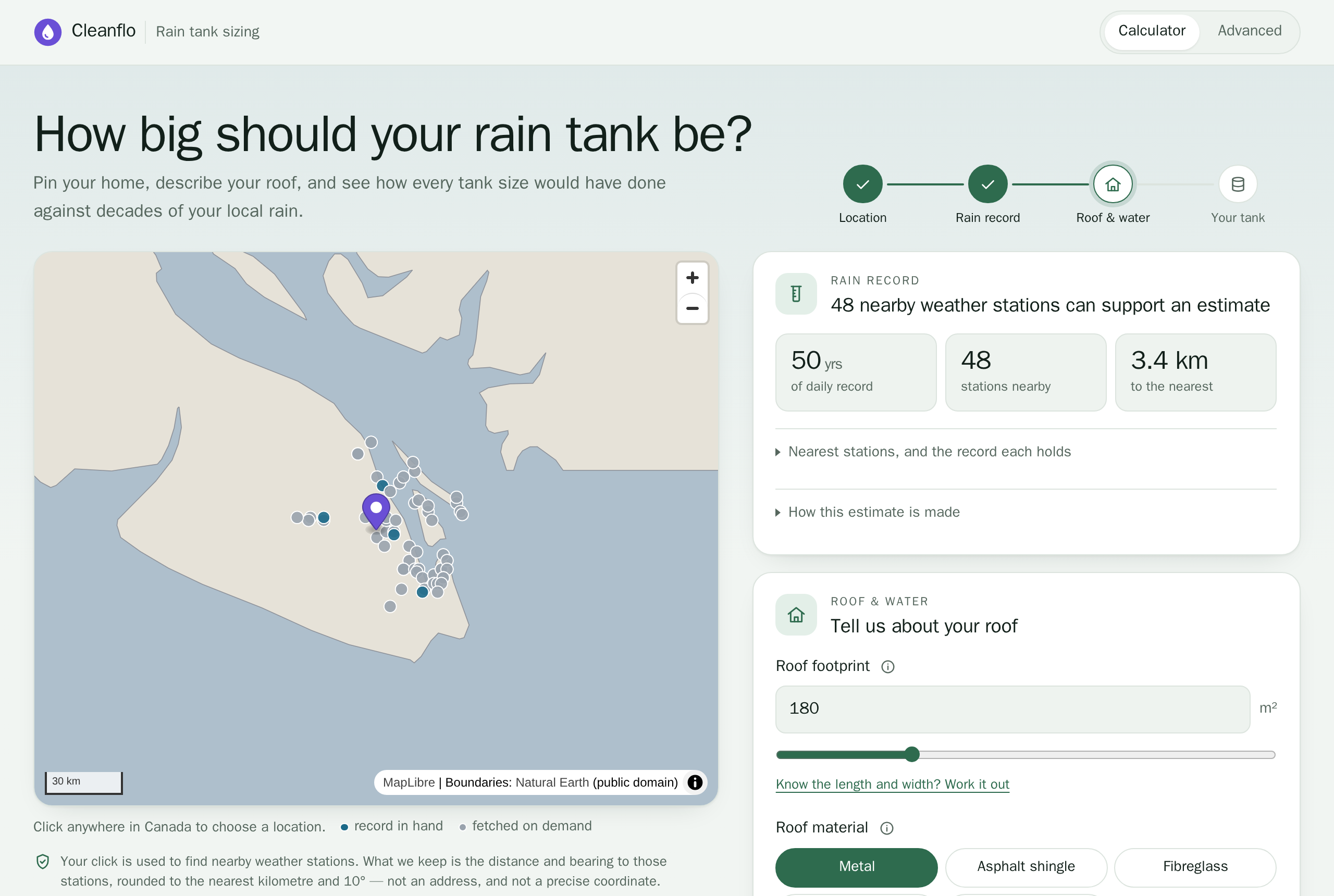
The Cleanflo rain tank sizing calculator: a map of Vancouver Island with a pin near Duncan, and a card saying 48 nearby weather stations can support an estimate, with 50 years of daily record.
Example for a sample location near Duncan, BC.

Why not just use the formula?

Our Rainwater Collection Calculation page shows how much water a year of rain puts off your roof. That is your supply. It can’t tell you the tank size, because rain doesn’t fall on the days you use water. A dry August can empty a tank that looks generous on paper.

The yearly formula

Roof area × a year of rain = litres a year. Good for the big picture. Silent about dry spells.

The daily simulation

Every day of every year on record: rain in, water used, overflow when the tank is full, and every day it runs dry. That is what sizes a tank.

How it works

1

Pin your home

Tap the map where your tank will go. The calculator finds the Environment and Climate Change Canada weather stations around you and blends their daily records by distance.

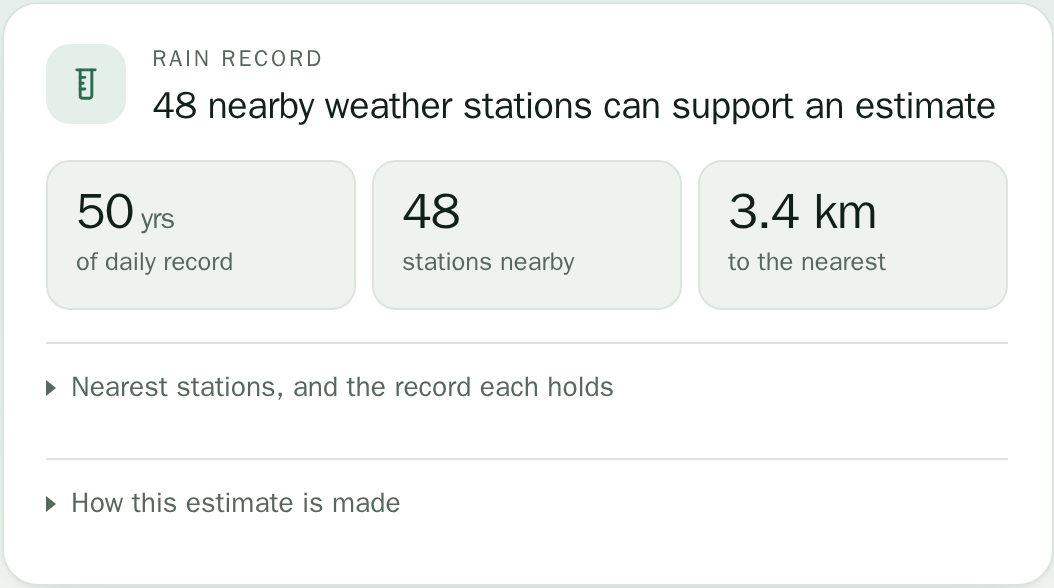
It needs at least 30 years of daily history to size a tank. Where there isn’t enough, it tells you so instead of guessing.

The calculator's rain record card: 50 years of daily record, 48 stations nearby, 3.4 km to the nearest.

2

Describe your roof and your water

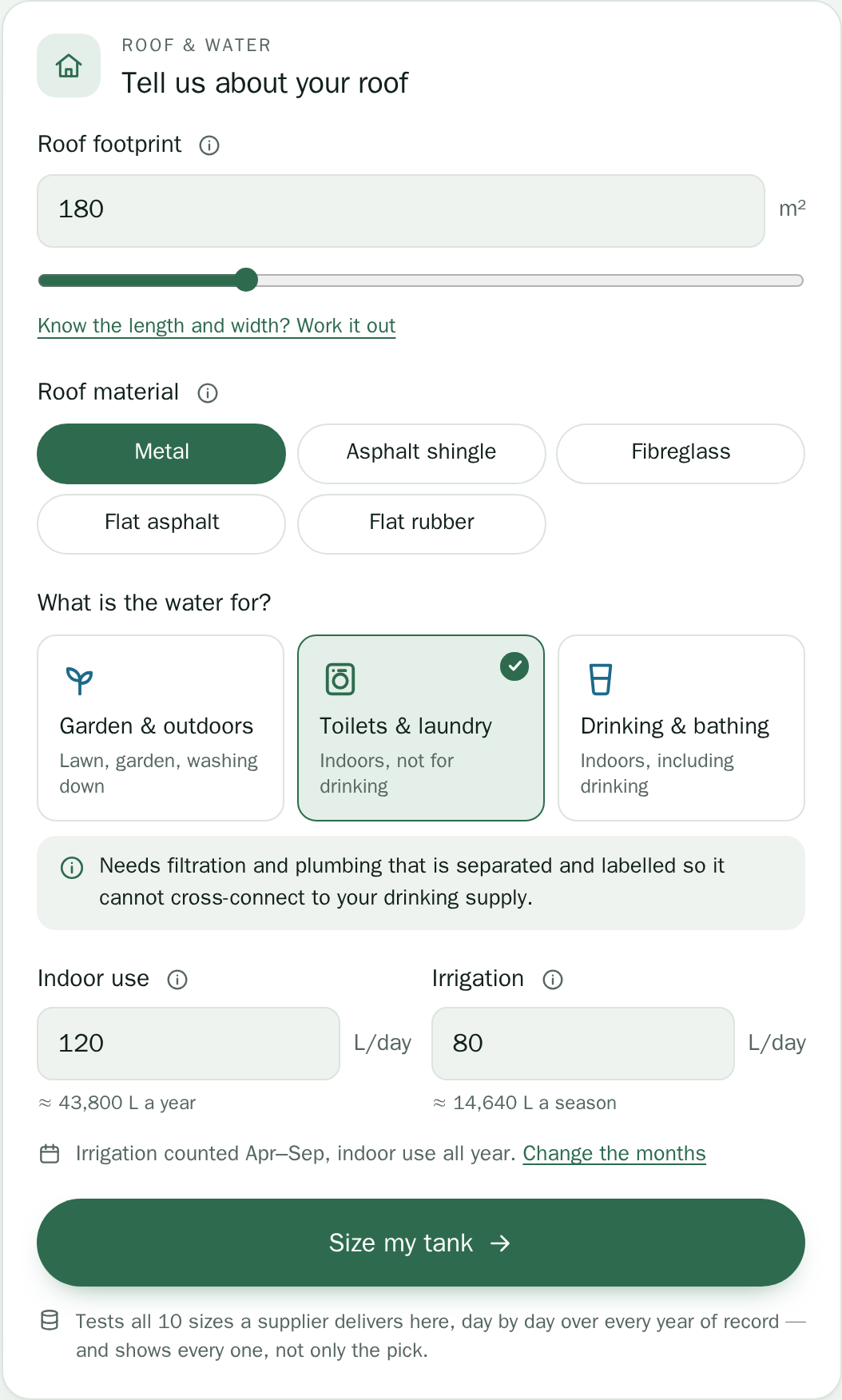
Your roof’s footprint (a length × width helper does the maths), what it’s made of, and what the water is for: the garden, toilets and laundry, or drinking and bathing.

Then the litres a day you use indoors and outdoors. The form shows what that adds up to over a year.

The calculator's roof and water form: roof footprint 180 square metres, a metal roof, toilets and laundry selected, 120 litres a day indoors and 80 litres a day for irrigation.

3

Get your tank size

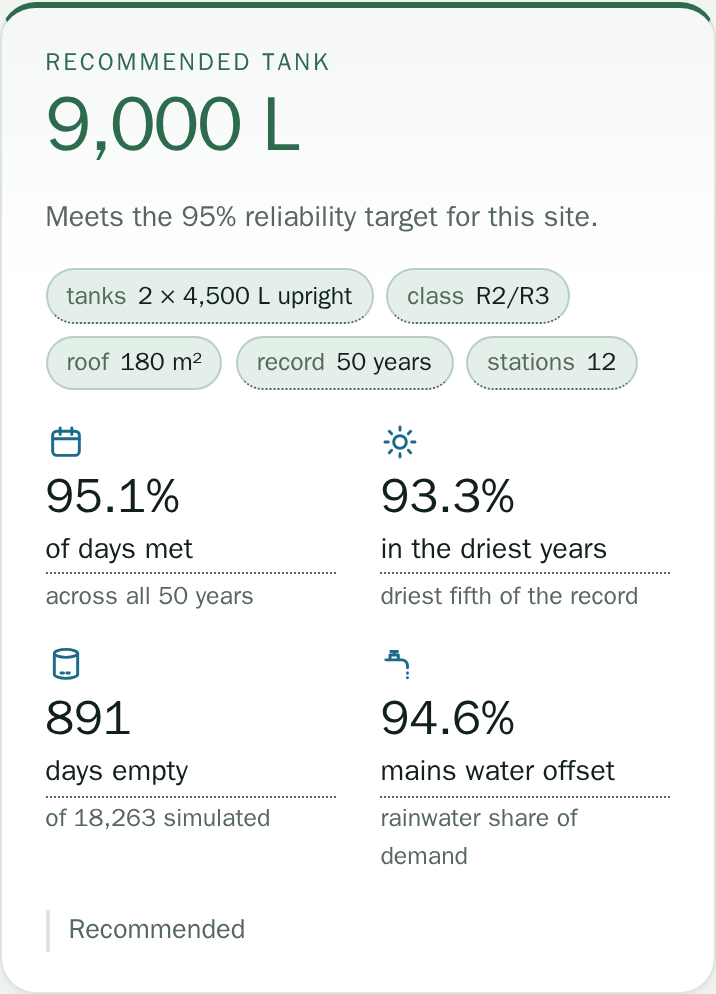
The smallest tank that meets the target: your use covered on at least 95% of days across the whole record, and holding up in the driest years. Beside it: how many days it would have run empty, and how much mains water it replaces.

When the right size is two tanks plumbed together, it says so. If even the largest size falls short, it says that plainly too.

An example answer on a phone: recommended tank 9,000 litres, as two 4,500 litre tanks, meeting the 95% target, with 95.1% of days met across 50 years and 93.3% in the driest years.

4

See every size, every month

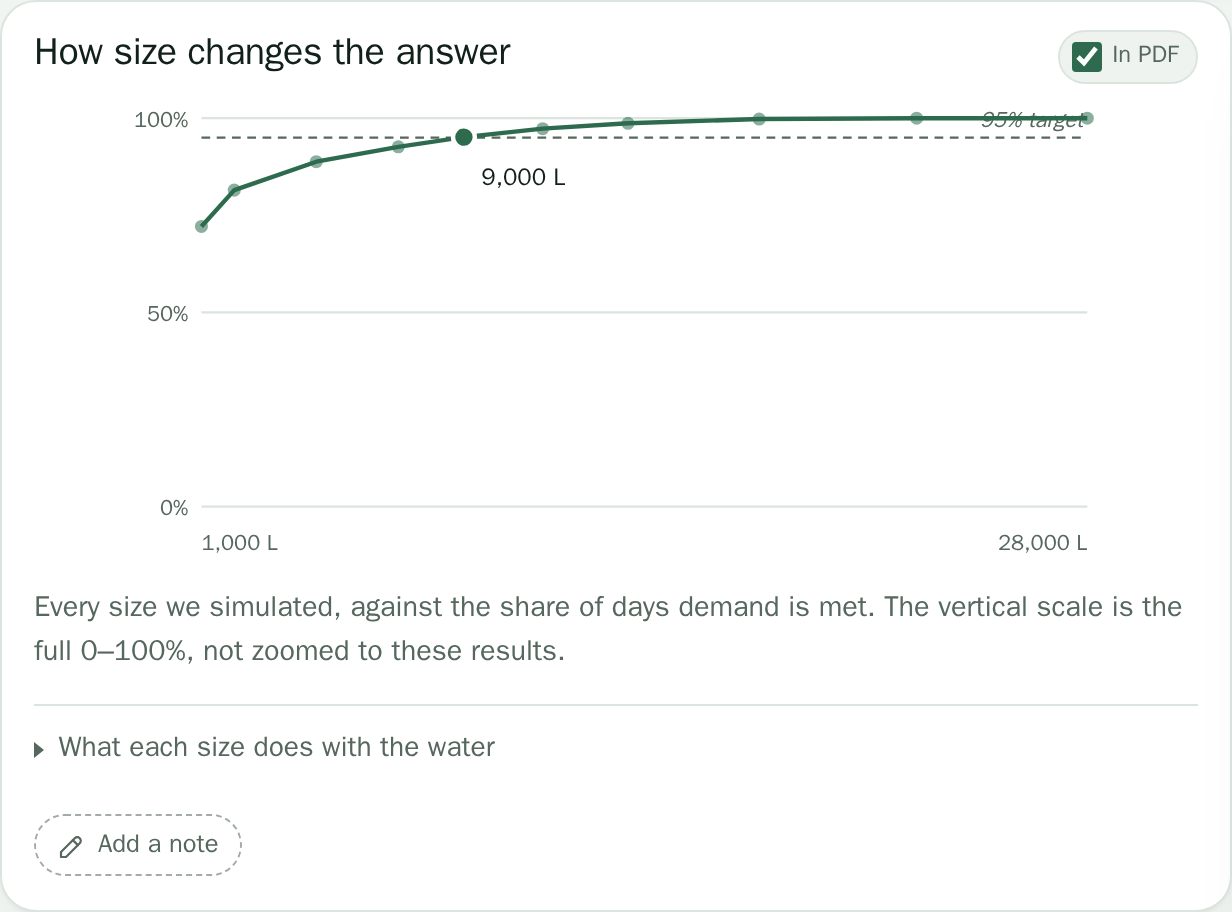
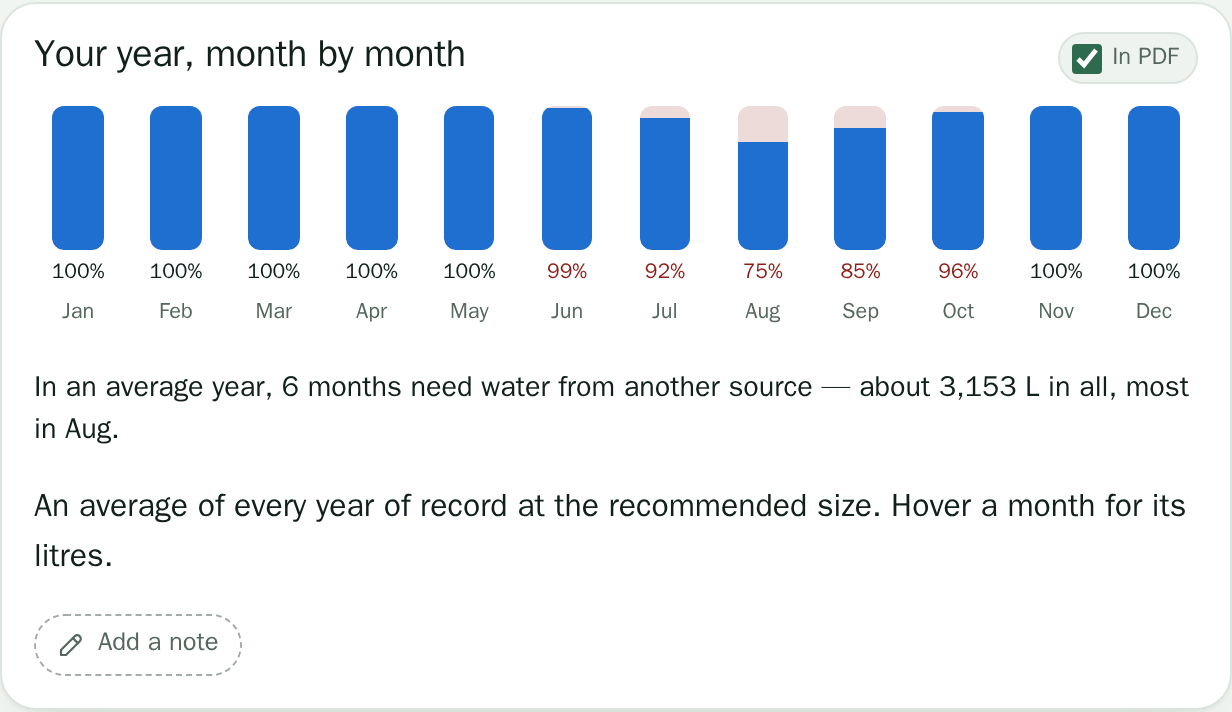
Every tank size it tested, not just the pick, so you can see where a bigger tank stops paying. The driest year is replayed day by day, and a month-by-month view shows when you would still need another source.

Save it as a PDF with your own notes, or share the link with your installer.

Chart: how size changes the answer. Reliability climbs from about 70% of days at 1,000 litres to the 95% target at 9,000 litres, then levels off near 100%.
Chart: your year, month by month. The tank covers 100% of demand from November to May, dipping to 75% in August.

What’s inside

Real Canadian weather

Daily records from Environment and Climate Change Canada stations near you, decades deep.

Sizes you can buy

Sizes a supplier delivers to your area, multi-tank setups included, priced as ranges with delivery. Where none delivers, it says the sizes are indicative.

Honest about gaps

Too little weather history? It refuses to size rather than invent an answer, and a missing day is never counted as a dry one.

Your whole year

Month by month: when the tank covers you, and when you would top up from another source.

Private by design

A report link carries no address and no coordinates, only distance and bearing to the weather stations.

Advanced settings

Choose the months each use applies, size against one station’s record, or test every size up to cistern scale.

The Advanced calculator

For installers and the curious, the Advanced page opens the settings most people never need:

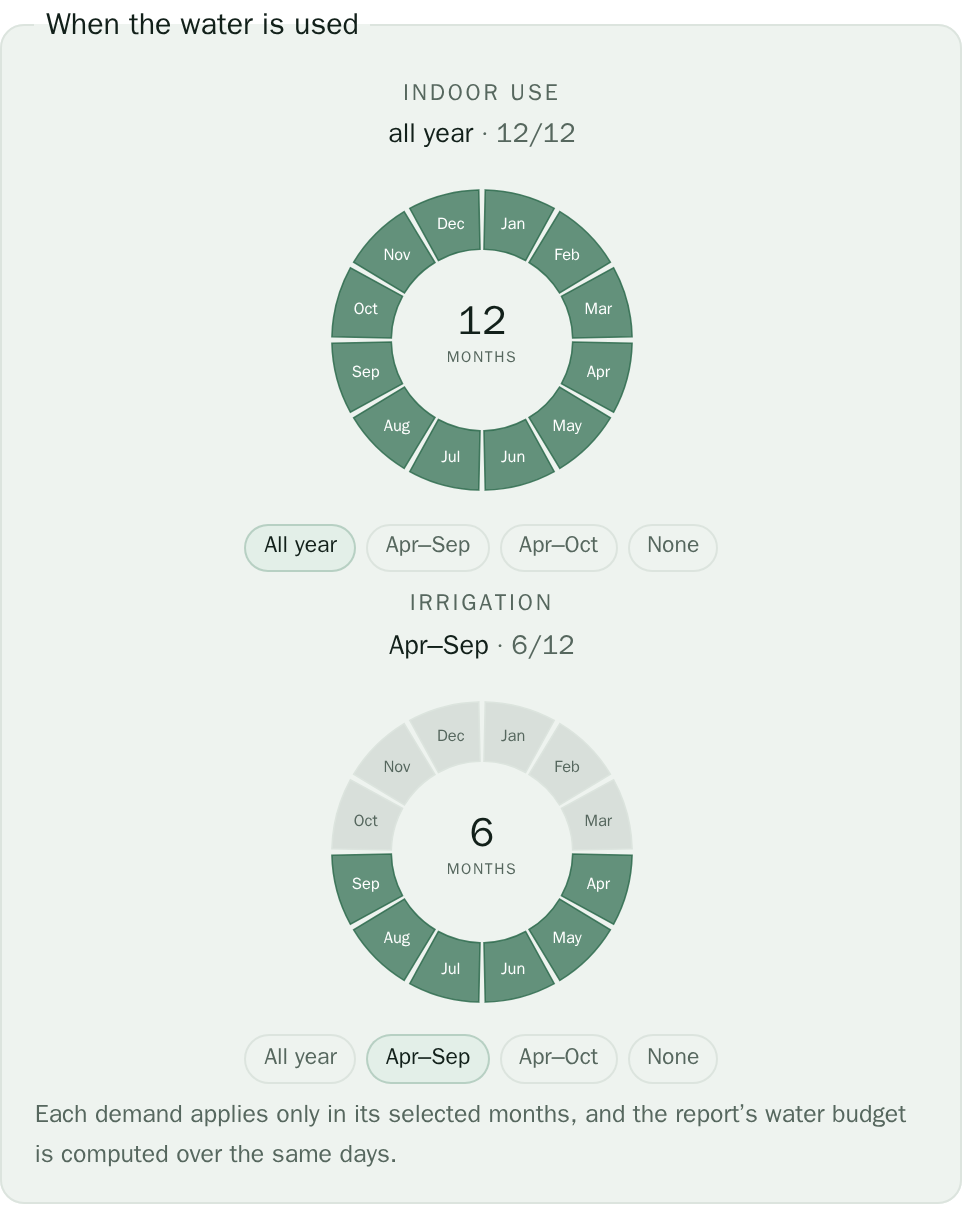
  • When each use applies. Indoor use all year, a garden April to September, or a cottage open May to October.
  • One weather station. Size against a single station’s record and the years you choose.
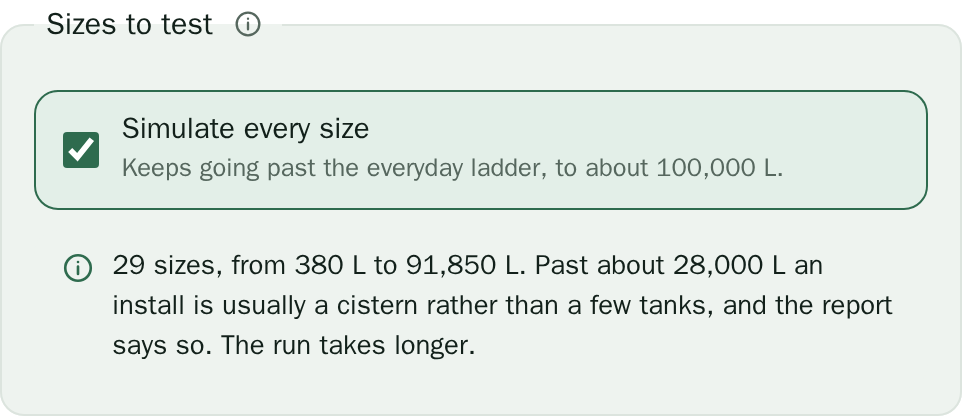
  • Simulate every size. The everyday range stops near 30,000 L and four tanks. Tick it to keep going to about 100,000 L, for sites that need a cistern.
The Advanced page's month rings: indoor use all twelve months, irrigation April to September.
The Simulate every size checkbox, ticked: 29 sizes from 380 litres to 91,850 litres.

Using rainwater for drinking?

Rainwater for drinking, cooking or bathing needs filtration and disinfection, and your local health authority has to approve the system. Rainwater for toilets and laundry needs plumbing that is separated and labelled so it cannot cross-connect with your drinking supply. The calculator sizes storage; it does not test or certify water quality.

Results are estimates from past weather, and future years will differ. Where a supplier delivers to your area, prices are shown as ranges that include delivery; a firm quote depends on your site, access and installation.

Ready to size your tank?

Pin your home and get an answer for your roof.

Want it designed and installed?

Cleanflo Water Technologies designs and installs complete rainwater harvesting systems. Click the logo for a free quote.

Cleanflo Water Technologies logo

← Back to the Learning Portal